
In today’s fast-moving startup world, the Startup Booted Fundraising Strategy is reshaping how founders build companies in the USA and beyond. Instead of chasing investors, modern entrepreneurs now focus on bootstrapped startup funding and early revenue generation to stay independent. This shift supports a strong revenue-first startup strategy, where real customers validate ideas instead of venture capital firms.
As competition increases, many founders prefer startup without venture capital approaches because they reduce risk and increase control. Ultimately, this method reflects a smarter startup bootstrapping strategy that prioritizes sustainable growth, financial discipline, and long-term stability over quick funding rounds and short-term hype in the startup ecosystem.
What Is a Startup Booted Fundraising Strategy?
A startup booted fundraising strategy is a business model where founders grow using revenue instead of venture capital. It supports startup without venture capital thinking and focuses on early customer payments. This approach builds a bootstrapped business model where cash flow is the main fuel of growth.
This model is powerful because it forces discipline. Founders focus on generate revenue from startup early instead of waiting for investors. It also builds a founder-led fundraising model where decisions stay in the hands of the creator, not external stakeholders.
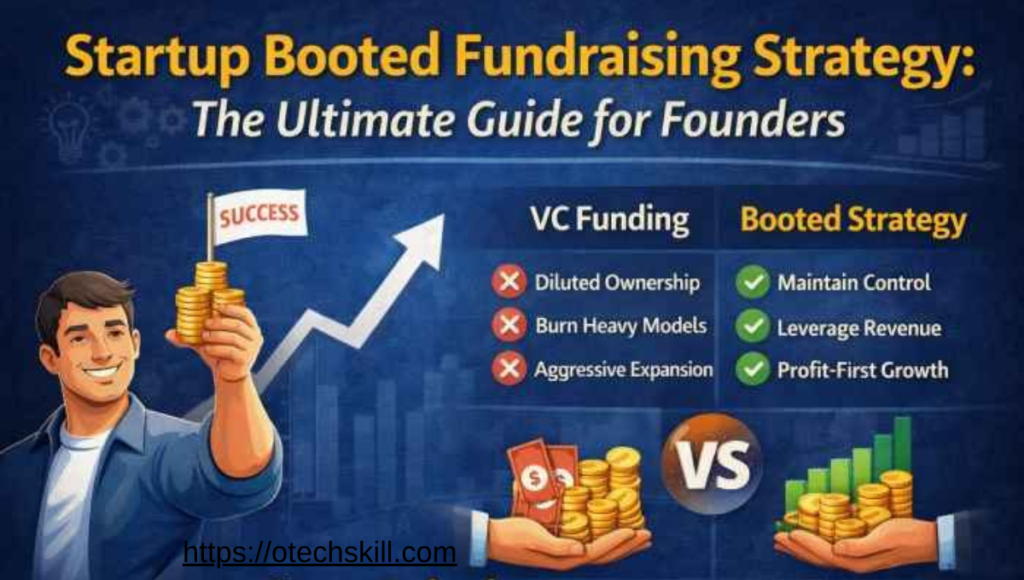
| Traditional Model | Booted Fundraising Model |
|---|---|
| Investor driven | Revenue driven |
| High burn rate | Controlled spending |
| Equity dilution | Full ownership |
| Growth pressure | Sustainable scaling |
Why Founders Are Choosing Booted Fundraising in 2026

Many USA founders now prefer startup bootstrapping strategy because it reduces dependency and increases stability. Investors are more selective, so founders turn toward non-dilutive startup funding methods that rely on real sales instead of equity selling.
This approach also supports startup financial independence strategy where founders control timing, pricing, and product direction. It allows businesses to grow based on real market demand instead of investor expectations.
Modern startups value sustainable startup growth strategy because it ensures long-term survival. Instead of chasing hype, they focus on real users, real revenue, and real impact.
Bootstrapping vs Venture Capital vs Booted Fundraising
Bootstrapping means building slowly with personal savings. Venture capital means rapid scaling with external money. But startup booted fundraising strategy sits in the middle and offers balance between control and growth.
This model is widely adopted because it supports build startup without investors mindset while still allowing expansion. It reduces risk and improves decision-making quality.
| Model | Speed | Risk | Control | Profit Focus |
|---|---|---|---|---|
| Bootstrapping | Slow | Low | Full | High |
| Venture Capital | Fast | High | Low | Growth |
| Booted Fundraising | Balanced | Medium | High | Balanced |
Types of Booted Fundraising Strategies
Different founders apply different versions of startup bootstrapped funding depending on their business model. Some rely on services, others on digital products, and some on hybrid systems.
The most common approach is customer funded growth model, where early users pay upfront. Another model is service-based revenue that funds product development. SaaS startups often use subscription income to scale.
Each type supports early stage startup revenue generation and helps reduce dependence on external capital. This creates stronger financial stability and faster validation.
Step-by-Step Execution of a Booted Fundraising Strategy
A strong startup bootstrapped strategy starts with identifying real problems in the market. Founders in the USA often begin by testing ideas quickly and charging early customers.
Then they move toward building a simple MVP. This helps validate demand and supports how to grow startup without funding in a structured way. Early revenue becomes proof of concept.
The final stage is reinvestment. Every dollar earned is reinvested into growth. This cycle builds a strong startup cash flow management strategy that supports long-term scaling.
Revenue & Pricing Strategy for Bootstrapped Startups
Pricing plays a key role in startup profitability over funding. Founders often use value-based pricing instead of discount-heavy models. This ensures better margins and stronger sustainability.
A smart bootstrapped startup funding approach includes multiple revenue streams. These may include services, subscriptions, and digital products. This diversification improves stability.
A simple breakdown:
| Revenue Type | Example | Stability |
|---|---|---|
| Services | Consulting | High short-term |
| Products | Templates | Medium |
| SaaS | Subscriptions | Long-term |
This structure strengthens startup growth without investors and improves financial control.
Growth Strategies Without Investors
Growth without investors depends heavily on organic systems. Founders use SEO, content, and communities to scale. This supports how bootstrapped startups scale without high costs.
They also rely on partnerships and digital marketing. These methods build long-term traffic instead of short-term spikes. It strengthens sustainable startup growth strategy and reduces acquisition costs.
AI tools now help founders automate marketing, product development, and customer support. This improves efficiency and supports startup financial independence strategy.
Risks, Challenges & Common Mistakes
Even strong founders struggle with startup booted fundraising strategy execution. One major mistake is scaling too early without stable revenue. This leads to cash flow problems and weak sustainability.
Another challenge is poor pricing. Many founders undervalue their product, which reduces long-term profit. This weakens startup cash flow management strategy and slows growth.
Common mistakes include:
| Mistake | Impact |
|---|---|
| Early scaling | Financial stress |
| Low pricing | Weak profit |
| Single revenue source | High risk |
Avoiding these issues improves startup profitability over funding and long-term survival.
When Booted Fundraising Works Best (and When It Doesn’t)
This model works best in digital industries like SaaS, consulting, and online tools. These markets support startup without venture capital because they allow fast monetization.
However, it does not work well in capital-heavy industries like hardware or biotech. These require large upfront investment and long development cycles.
The decision depends on market type and revenue speed. Founders should evaluate whether they can achieve generate revenue from startup early before choosing this model.
Case Study: Real-World Bootstrapped Success
Mailchimp is a strong example of startup bootstrapped funding success. It grew without venture capital for many years. The company focused on customer needs and slow, stable growth.
This approach proved that self-funded startup growth can reach billion-dollar scale. It also showed that patience and discipline matter more than funding speed.
Final Thoughts
The startup booted fundraising strategy is changing how founders build companies in the USA. It promotes independence, control, and real financial discipline.
Instead of chasing investors, founders now focus on startup profitability over funding and long-term sustainability. This shift builds stronger businesses with real market validation.
In the end, revenue is more powerful than funding. Businesses that master startup growth without investors create lasting success in any market condition.
FAQs: Startup Booted Fundraising Strategy
1. What is a Startup Booted Fundraising Strategy?
It is a revenue-first startup strategy where founders grow using customer income instead of venture capital or external investors.
2. How does the Startup Booted Fundraising Strategy work?
It works by focusing on early sales, reinvesting profits, and scaling only through bootstrapped startup funding and real market demand.
3. Why do founders choose a Startup Booted Fundraising Strategy?
Founders prefer it because it offers full control, lower risk, and supports startup profitability over funding decisions.
4. Is Startup Booted Fundraising Strategy better than venture capital?
It depends, but many prefer it because it avoids dilution and builds stronger startup without venture capital independence.
5. Can startups scale without investors using this strategy?
Yes, many companies use a startup bootstrapping strategy to grow steadily through revenue and customer-funded growth.
6. What are the risks of a Startup Booted Fundraising Strategy?
The main risks include slower scaling and limited resources in the early stage compared to VC-backed startups.
7. Which businesses work best with this strategy?
Digital businesses like SaaS, services, and online tools perform best due to fast early stage startup revenue generation potential.
You May Be Read Also: Startup Booted Fundraising Strategy